The Room That Changes Your Mind in Ten Minutes
Everyone in Miami has been to a Goodwill South Florida store. Almost nobody has been inside the factory.
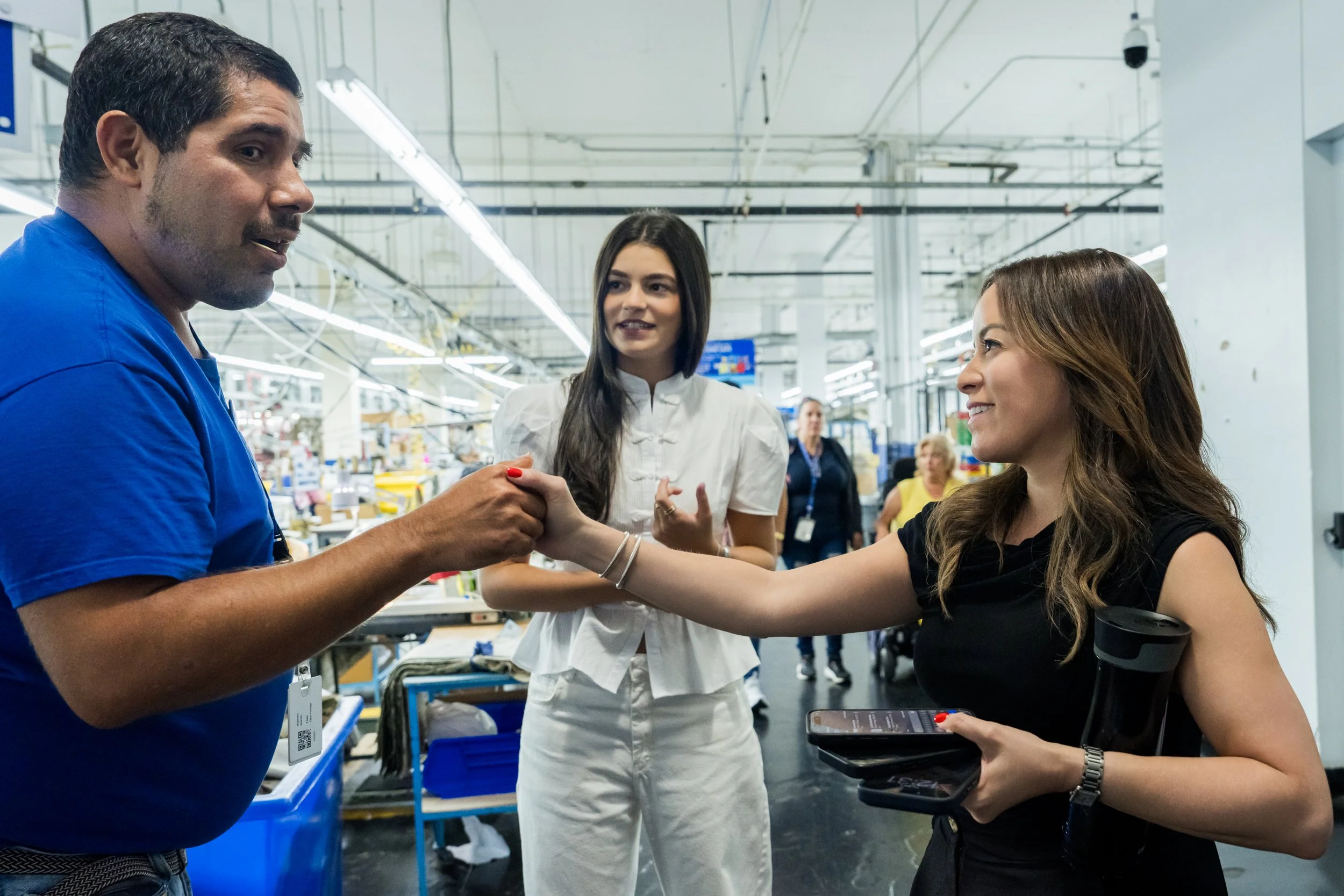
You have driven past the building. Everyone in Miami has driven past the building.
It sits on Northwest 21st Street in Allapattah, and if you know the name Goodwill at all, you know it from the stores. The one on Bird Road. The one you dropped a bag at last spring. The one where somebody you know found a couch. That is the whole picture most of this city has. A place you give things to - and it is the number one thing Goodwill is known for nationwide… but Goodwill South Florida has a different story.
We spent two hours inside. Here is what we found.
Five hundred a day
Let’s start with the flag.
The U.S. interment flag is the one that drapes the casket at a military funeral, then gets folded into a triangle and placed in the hands of a family. It is, arguably, the most consequential flag the country makes. Goodwill South Florida manufactures it under contract with the Department of Veterans Affairs, at a site their CEO describes as one of the largest producers of U.S. flags in the country. More than 85,000 come out of that building a year.
The star field is embroidered on the lower floor. It comes upstairs to have the stars and stripes applied, and then a team assembles it, a team on which 75% of people have a federally or state recognized disability. After that, three or four more people do nothing but trim thread. Every loose end, by hand, one flag at a time.
We asked why. The answer was that these flags end up displayed in living rooms across America, and the family receiving one should receive something perfect.
Five hundred come off that line every day. Since Goodwill South Florida began flag operations thirty years ago, its flags have been part of more than two and a half million burials.
This is a factory
The Ryder Apparel Manufacturing Division is the largest apparel manufacturing operation in the southeastern United States. More than two thousand sewing machines. Nine hundred and sixty employees producing over a million apparel and textile items a year for the U.S. Army, the Defense Logistics Agency, and commercial clients, as they have for more than thirty years.
None of that comes with an allowance for good intentions. The division is ISO 9001:2015 certified for manufacturing military uniforms and textile goods. It delivers on time more than 95% of the time. Last year it cut throughput from seventy-two hours to eight.
That inverts the usual story. This is not a charity that also makes things. This is a manufacturer that has organized itself so the people the labor market writes off can meet a federal standard, and then meets it, on schedule, at scale.
The pocket
The best thing we saw took about four seconds.
A woman on the line was marking a piece of fabric, indicating exactly where a pocket needed to be placed. It is a step built into the process on purpose. She does it because the next person on the line has a disability, and the mark means that person can lay the pocket in exactly the right spot, every time.
That is the entire organization in one small design decision. Nobody lowered the standard. Somebody built a better way to reach it.
The floor is full of this. A sheet of plexiglass at one station. Neurodiverse employees placed on manual operations rather than needle machines, not to limit them but because that is where the work and the person fit. A screen above the line showing supervisors in real time where a job is slowing down, so people can be moved to clear it before it becomes a problem for anyone.
The part that falls below the line
Three quarters of the employees on that floor have a federally recognized disability. But the mission statement says disabilities and other barriers to work, and the second half of that phrase is doing quiet, enormous work.
A barrier is not always a diagnosis. Goodwill's own community needs assessment asked people across South Florida what stood between them and steady work, and the answers were plain. Housing costs, cited by 49% of respondents. Wages that don't cover a family, cited by 30%. Transportation that doesn't reliably get you to a shift, cited by 26%. Mental health care that isn't there when you need it.
None of those come with a designation or a benefit. They derail a working life anyway.
That gap is where a lot of South Florida lives. More than half of Miami-Dade households, 51%, earn above the federal poverty line but below what it actually costs to live here. In Broward it's 46%. These are working people who cannot afford the basics.
Goodwill is one of the few employers in this region organized around that fact.
The band
Upstairs, there is a room with a stage.
The Spirit of Goodwill Band has been playing for more than thirty years. Every member is a full-time Goodwill employee. They work in the mail shop, on the sewing floor, in the stores, and Goodwill gives them two hours every Wednesday and Thursday to rehearse.
It started as a chorus. Someone donated instruments. That was three decades ago.
Last year they released their first professional album, produced with Grammy Award winning artist James Fauntleroy.
Goodwill's own description of them is the line we can't improve on: if you ask members of the band what they have wanted all their life, it is one thing. That the world could see their talent.
Jacel
In September 2005, a young man named Jacel Peart finished at Miami-Dade County Public Schools and entered Goodwill's Adult Day Training program. He had no work experience.
In the program, he worked as a bench worker, preparing and packaging cinnamon bottles. He stood out for consistency and for pride in the work.
In May 2023, he was hired as a material handler.
Eighteen years from the day program to the payroll. Goodwill named him an Achiever of the Year in 2025.
That is what the whole apparatus, the training centers, the job coaches, the supported employment program, the factory itself, is built to produce. Not a feeling. A hire.
The numbers, for the record
In 2025, Goodwill South Florida served 6,960 people, provided 10,528 services, and placed 953 individuals into jobs. It operates five businesses generating $184.5 million in revenue, employs roughly 3,000 people, and is the largest employer of people with disabilities and barriers to work in Florida. It diverted 62 million pounds from landfills, about 2,500 garbage trucks.
It has been doing this since 1959.
Why we went
Worth Knowing exists because the organizations doing the hardest work in this city are often the ones it knows least about. People recognize the name. They have driven past the building a hundred times. Almost none of them have ever been inside.
Every one of these organizations has a room in it that would change your mind in ten minutes. A workshop, a classroom, a kitchen, a garden. Worth Knowing is how we walk in and bring it back out.
At Goodwill South Florida, that room has five hundred flags in it, and a woman marking a pocket so her coworker can do his job.
Learn more and get involved at goodwillsouthflorida.org.
Their gala, Rhythm & Threads, is on November 14th at Fontainebleau Miami Beach. Revolve Group will be there, and we'd be glad to see you.
Photography provided by Revolve Group.
